




What do all the letters and numbers in the lens names mean?
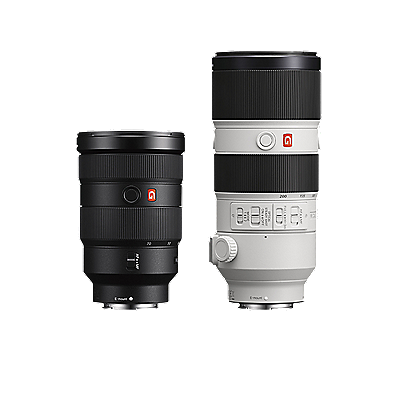
The letters and numbers in the lens name indicate the focal length, F-value, lens features, and more.
E-mount lens names
- 1: Focal length: When this value is a range, the lens is a zoom lens. When this value is a single number, the lens is a prime/single focus lens.
- 2: F-value: This is the aperture of the lens.
- 3: E-mount lenses start with SEL.
Typical codes used at the beginning of a lens name:
- E
- Denotes a lens for a camera with an APS-C size image sensor. When mounted on a camera with a 35 mm full-frame image sensor, the angle of view is cropped to APS-C size.
- PZ
- Denotes power zoom.
- FE
- Denotes a lens compatible with a camera that has a 35 mm full-frame image sensor.
- Sonnar T (etc.)
- Inserted at the beginning of a Carl Zeiss lens name.
Typical codes used at the end of a lens name:
- G
- Denotes a G lens.
- GM
- Denotes a Sony Premium G Master Series lens.
- ZA
- Denotes a Carl Zeiss lens.
- Macro
- Denotes a macro lens.
- OSS
- Denotes an in-lens optical camera-shake compensation function.
- LE
- Denotes a Light Edition lens. This edition achieves lighter weight and downsizing.
- II, 2
- The number 2 at the end indicates that it is the second generation.
Examples:- FE 24-70mm F2.8 GM II (SEL2470GM2)
- E PZ 16-50mm F3.5-5.6 OSS II (SELP16502)
A-mount lens names
- 1: Focal length: When this value is a range, the lens is a zoom lens. When this value is a single number, the lens is a single focus lens.
- 2: F-value: This is the aperture of the lens.
- 3:A-mount lenses start with SAL.
Typical codes used at the beginning of a lens name:
- DT
- Denotes a lens for a camera with an APS-C size image sensor. A lens whose name has no DT at the beginning is compatible with a camera that has a 35 mm full-frame image sensor.
- Sonnar T (etc.)
- Inserted at the beginning of a Carl Zeiss lens name.
Typical codes used at the end of a lens name:
- G
- Denotes a G lens.
- ZA
- Denotes a Carl Zeiss lens.
- Macro
- Denotes a macro lens.
- Fisheye
- Denotes a fisheye lens.
- SSM
- Denotes a Super Sonic wave Motor.
- SAM
- Denotes a Smooth Autofocus Motor.
- II, 2
- The number 2 at the end indicates that it is the second generation.
Examples:- 300mm F2.8 G SSM II (SAL300F28G2)
- 70-300mm F4.5-5.6 G SSM II (SAL70300G2)
Note: SSM and SAM are types of autofocus drive control systems.
The F-value indicated by the name of a lens is the F-value when the lens is wide open (i.e., the minimum F-value). The smaller the value, the faster the lens is. For more information, refer to Aperture (F-number) and A-Mode.
Note: The following depend on the combination of lens and camera body:
- The firmware of the lens or camera body may need to be updated.
- Some functions may not be available.
- Some precautions or limitations apply when using the products.
Refer to the Lens - Compatibility Information page for additional lens and compatibility information.
Repair & Warranty
Book, track or maybe even avoid a repair
Contact support
Contact our Support team
Support by Sony (Mobile App)
Never miss an update again! Find information and receive instant notifications about your product

